Diagnosis of the level of knowledge about coffee cultivation in mountainous areas of southwest Granma
Article Sidebar
Main Article Content
Abstract
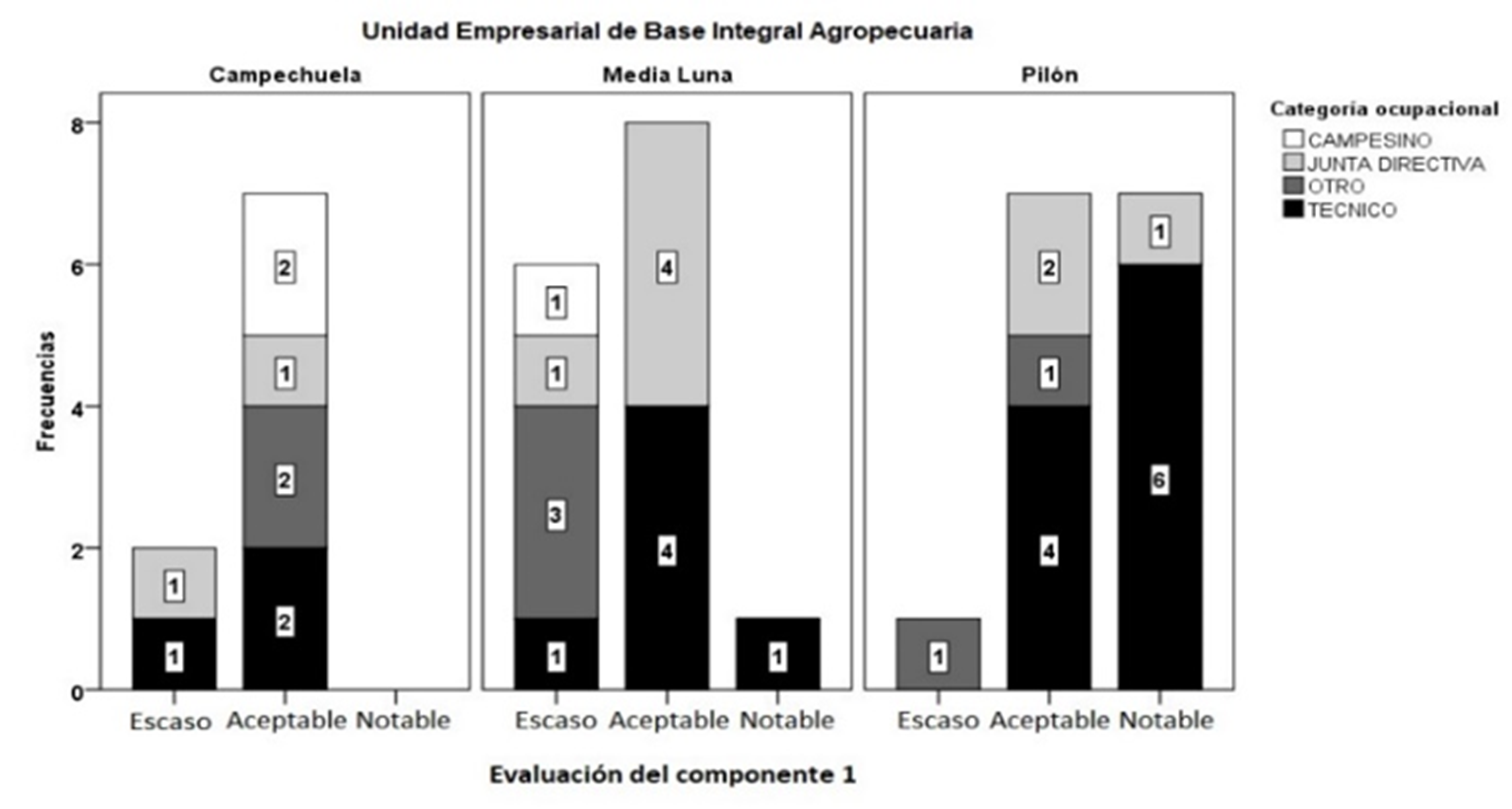
Coffee cultivation in the mountainous areas of Granma is key to the socioeconomic development of rural communities, but the variability in agricultural knowledge limits its productivity. This study aimed to assess the level of knowledge about coffee cultivation among producers in three municipalities in southwestern Granma (Pilón, Media Luna, and Campechuela) to identify training needs. A 10-item questionnaire was administered to 39 participants (farmers, technicians, and officials), evaluating aspects such as propagation, regulations, and agronomic management. Data were analyzed using descriptive statistics, Cronbach's alpha (α = 0.701) and factor analysis (KMO = 0.629), which identified three components explaining 65.5% of the variance. The results showed acceptable knowledge of agricultural practices (Component 1), but limited knowledge of regulations and development programs (Components 2 and 3), especially in Media Luna. It is concluded that, although the instrument was reliable, training in regulations and planning needs to be strengthened, with emphasis on areas with lower performance.
Article Details

This work is licensed under a Creative Commons Attribution-NonCommercial 4.0 International License.
Those authors who have publications with this journal accept the following terms of the License Attribution-NonCommercial 4.0 International (CC BY-NC 4.0):
You are free to:
- Share — copy and redistribute the material in any medium or format
- Adapt — remix, transform, and build upon the material
The licensor cannot revoke these freedoms as long as you follow the license terms.
Under the following terms:
- Attribution — You must give appropriate credit, provide a link to the license, and indicate if changes were made. You may do so in any reasonable manner, but not in any way that suggests the licensor endorses you or your use.
- NonCommercial — You may not use the material for commercial purposes.
- No additional restrictions — You may not apply legal terms or technological measures that legally restrict others from doing anything the license permits.
The journal is not responsible for the opinions and concepts expressed in the works, they are the sole responsibility of the authors. The Editor, with the assistance of the Editorial Committee, reserves the right to suggest or request advisable or necessary modifications. They are accepted to publish original scientific papers, research results of interest that have not been published or sent to another journal for the same purpose.
The mention of trademarks of equipment, instruments or specific materials is for identification purposes, and there is no promotional commitment in relation to them, neither by the authors nor by the publisher.
How to Cite
References
Frías, D., & Pascual, M. (2012). Prácticas del análisis factorial exploratorio (AFE) en la investigación sobre conducta del consumidor y marketing. Suma Psicológica, 19(1), 47-58. https://dialnet.unirioja.es/servlet/articulo?codigo=4112682
Jansen, H. (2013). La lógica de la investigación por encuesta cualitativa y su posición en el campo de los métodos de investigación social. Paradigmas, 5(1), 39-72.
Lloret, Segura., Ferreres, A., Hernández, A., & Tomás, I. (2014). El análisis factorial exploratorio de los ítems: Una guía práctica, revisada y actualizada. Anales de psicología, 30(3), 1151-1169. https://doi.org/10.6018/analesps.30.3.199361
Ministerio de la Agricultura. (2009). Norma ramal 132:2009. Posturas de café. Especificaciones de calidad (2.a ed.). Departamento de Calidad (DC).
Ministerio de la Agricultura. (2011). Norma ramal 194:2011. Semillas de café (Coffea arabica, L y Coffea canephora P ex. F) (1.a ed.). Dirección de Calidad (DC).
Naranjo, O. (2024). Cultura cafetalera con impacto de ciencia-La Demajagua [Diario Digital de la provincia de Granma, Cuba]. La Demajagua. https://lademajagua.cu/cultura-cafetalera-con-impacto-de-ciencia/
Nariño-Nariño, A., Lambertt-Lobaina, W., Menéndez-Grenot, M., Durán, O. S., Matos-Cueto, Y., & Clapé-Borges, P. (2014). Experiencias del proyecto recuperación, desarrollo y mejoramiento de la producción agroecológica del cacao en el municipio de Baracoa, Cuba. Café Cacao, 13(2), Article 2. https://cafecacao.edicionescervantes.com/index.php/cafecacao/article/view/102
Rodríguez, J., & Reguant, M. (2020). Calcular la fiabilidad de un cuestionario o escala mediante el SPSS: el coeficiente alfa de Cronbach. REIRE Revista d’Innovació i Recerca en Educació, 13(2), 1-13. https://doi.org/10.1344/reire2020.13.230048
Sánchez, L. (2012). Orientaciones de carácter metodológico para el uso del análisis factorial con SPSS en las investigaciones. Universidad de Matanzas “Camilo Cienfuegos”. http://monografias.umcc.cu/monos/2012/FUM%20Limonar/mo1283.pdf