Micronutrient content of Coffea arabica L. varieties in the coffee-growing town of Jibacoa
Article Sidebar
Main Article Content
Abstract
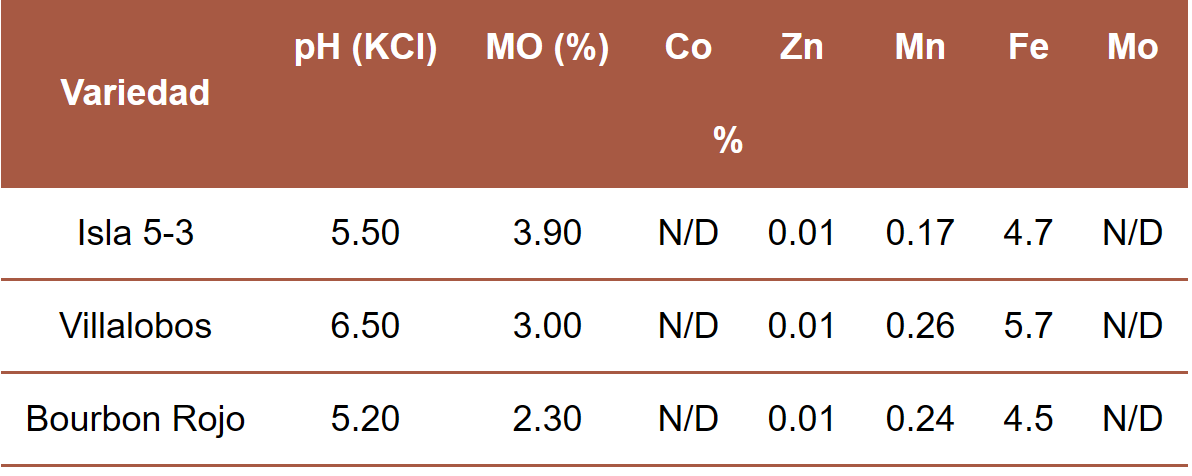
The study of micronutrients in coffee is key to optimizing fertilization and improving crop productivity. This study evaluated foliar contents of Zn, Fe, Mn, Mo, and Cu in three varieties of Coffea arabica (Isla 5-3, Villalobos, and Bourbon Rojo) grown in reddish-brown Fersialitic soils in Jibacoa, Cuba. Leaves were collected in 2020 and 2023, washed, dried, and analyzed by atomic absorption spectrophotometry. Data were processed with ANOVA and Tukey's test (p ≤ 0.05). The results showed significant differences between varieties: Villalobos presented higher contents of Zn and Mn in 2020, but lower contents of Fe and Cu in 2023. The order of abundance was Mn > Fe > Cu > Mo > Zn, with interannual variability linked to genetic and environmental factors. It is concluded that foliar micronutrients depend on variety, agronomic management, and soil and climate conditions, highlighting the need to adjust fertilization recommendations accordingly.
Article Details

This work is licensed under a Creative Commons Attribution-NonCommercial 4.0 International License.
Those authors who have publications with this journal accept the following terms of the License Attribution-NonCommercial 4.0 International (CC BY-NC 4.0):
You are free to:
- Share — copy and redistribute the material in any medium or format
- Adapt — remix, transform, and build upon the material
The licensor cannot revoke these freedoms as long as you follow the license terms.
Under the following terms:
- Attribution — You must give appropriate credit, provide a link to the license, and indicate if changes were made. You may do so in any reasonable manner, but not in any way that suggests the licensor endorses you or your use.
- NonCommercial — You may not use the material for commercial purposes.
- No additional restrictions — You may not apply legal terms or technological measures that legally restrict others from doing anything the license permits.
The journal is not responsible for the opinions and concepts expressed in the works, they are the sole responsibility of the authors. The Editor, with the assistance of the Editorial Committee, reserves the right to suggest or request advisable or necessary modifications. They are accepted to publish original scientific papers, research results of interest that have not been published or sent to another journal for the same purpose.
The mention of trademarks of equipment, instruments or specific materials is for identification purposes, and there is no promotional commitment in relation to them, neither by the authors nor by the publisher.
How to Cite
References
Busato, C., dos Reis, E. F., Oliveira, M. G., de Oliveira Garcia, G., Busato, C. C. M., & Partelli, F. L. (2023). Acumulación de nutrientes e índices de clorofila en Coffea canephora como respuesta a las dosis de nitrógeno. Cultivos Tropicales, 44(4), 1-11.
Castañeda-Castro, O. (2018). Variaciones en área foliar y concentraciones de clorofilas y nutrimentos esenciales en hojas de café robusta (Coffea canephora P.) durante un ciclo anual. Agro Productividad, 11(4), 36-41.
Di Rienzo, J. A., Casanoves, F., Balzarini, M. G., Gonzalez, L., Tablada, M., & Robledo, C. W. (2014). InfoStat versión 2014. InfoStat Group, Facultad de Ciencias Agropecuarias, Universidad Nacional de Córdoba, Argentina. URLhttp://www.infostat.com.ar
Díaz, W., Caro, P., Bustamante, C., Sánchez, C., Rodríguez, M., & Vázquez, E. (2013). Instructivo Técnico Café Arábico (Coffea arabica Lin). Instituto de Investigaciones Agro-Forestales: Ministerio de la Agricultura. Dirección de Café y Cacao del Grupo Empresarial de Agricultura de Montaña. Instituto de Investigaciones Agro-Forestales.
Ferrás, Y., González, C. A. B., Salina, V. P., Esmoris, C. S., & Espinosa, R. R. (2024). Vulnerabilidad y capacidad adaptativa al cambio climático en fincas cafetaleras de Jibacoa, Cuba. Agronomía & Ambiente, 44(1), 92-101.
Hernández, A., Pérez, J. M., Bosch, D., & Castro, N. (2015). Clasificación de los Suelos de Cuba. INCA.
Levene, H. (1960). Robust Tests of Homogeneity of Variance. Contributions to Probability and Statistics; Stanford University Press: Stanford, CA, USA, 278-292.
Lilliefors, H. W. (1967). On the Kolmogorov-Smirnov Test for Normality with Mean and Variance Unknown. Journal of the American Statistical Association, 62(318), 399-402. https://doi.org/10.1080/01621459.1967.10482916
López-Báez, W., Reynoso-Santos, R., Camas Gómez, R., & Santos-Clemente, E. (2019). Caracterización de los suelos cultivados con café (Coffea L.) en la sierra madre de Chiapas. México.
Marín-Garza, T., Gómez-Merino, F. C., Trejo-Téllez, L. I., Pastelín-Solano, M. C., & Castañeda-Castro, O. (2020a). POTENCIAL FUNCIONAL Y NUTRACÉUTICO DE HOJAS DE CAFÉ (Coffea ssp.) INJERTADO DURANTE UN CICLO ANUAL. Agrociencia, 54(4), 459-469. https://doi.org/10.47163/agrociencia.v54i4.2044
Marín-Garza, T., Gómez-Merino, F. C., Trejo-Téllez, L. I., Pastelín-Solano, M. C., & Castañeda-Castro, O. (2020b). Potencial funcional y nutracéutico de hojas de café injertado (coffea spp.) durante un ciclo anual. Agrociencia, 54(4), 459-469.
Martín, N. J. (2012). Tabla de interpretación de análisis de suelo. Departamento de Riego, Drenaje y Ciencias del Suelo. Facultad de Agronomía. UNAH, 20.
Sadeghian, S. (2018). Interpretación de los resultados de análisis de suelo Soporte para una adecuada nutrición de cafetales. Avances Técnicos Cenicafé, 1-8.
Sadeghian, S., & Salamanca, A. (2015). Micronutrientes en frutos y hojas de café. Cenicafé, 66(2), 73-87.
StatSoft, I. N. C. (2001). STATISTICA (data analysis software system), version 6. Tulsa, USA, 150, 91-94.
Tukey, J. W. (1953). The problem of multiple comparisons. Multiple comparisons. https://cir.nii.ac.jp/crid/1572543024859553152