Morphoagronomic evaluation of cocoa clones with high productive potential and quality
Article Sidebar
Main Article Content
Abstract
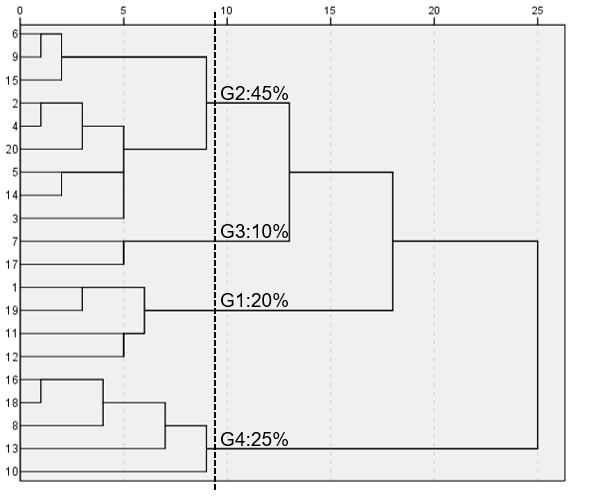
Cocoa (Theobroma cacao L.) is a crop of great economic importance in tropical regions, but its production faces challenges related to genetic variability and bean quality. This study aimed to morpho-agronomically evaluate cocoa clones with high productive and quality potential to identify superior genotypes. Twenty cocoa clones were characterized at the Agroforestry Research Institute (INAF) in Baracoa, Cuba, between December 2019 and November 2021. 15 morpho-agronomic descriptors were evaluated, including variables such as number of seeds per pod, seed dry mass, fat percentage, and industrial yield, using an experimental design and principal component analysis (PCA). The results showed that the first five PCA components explained 77.92% of the total variability, with the first component contributing 28.92%. The most influential variables were test percentage, seed dry mass, and number of seeds per pod. The 20 genotypes were grouped into four groups, with group four (G4) standing out for its high industrial yield (33.22%) and fat percentage (52.16%). Clones EICB-20, EICB-260, EICB-266, EICB-366 and CCN-51 were identified as the most promising for their quality and productivity characteristics. It was concluded that these genotypes are ideal for genetic improvement programs and production of high-quality cocoa. The identification of key descriptors optimizes future characterization studies and selection of superior clones.
Article Details

This work is licensed under a Creative Commons Attribution-NonCommercial 4.0 International License.
Those authors who have publications with this journal accept the following terms of the License Attribution-NonCommercial 4.0 International (CC BY-NC 4.0):
You are free to:
- Share — copy and redistribute the material in any medium or format
- Adapt — remix, transform, and build upon the material
The licensor cannot revoke these freedoms as long as you follow the license terms.
Under the following terms:
- Attribution — You must give appropriate credit, provide a link to the license, and indicate if changes were made. You may do so in any reasonable manner, but not in any way that suggests the licensor endorses you or your use.
- NonCommercial — You may not use the material for commercial purposes.
- No additional restrictions — You may not apply legal terms or technological measures that legally restrict others from doing anything the license permits.
The journal is not responsible for the opinions and concepts expressed in the works, they are the sole responsibility of the authors. The Editor, with the assistance of the Editorial Committee, reserves the right to suggest or request advisable or necessary modifications. They are accepted to publish original scientific papers, research results of interest that have not been published or sent to another journal for the same purpose.
The mention of trademarks of equipment, instruments or specific materials is for identification purposes, and there is no promotional commitment in relation to them, neither by the authors nor by the publisher.
How to Cite
References
Aikpokpodion, P. O. (2012). Defining Genetic Diversity in the Chocolate Tree, Theobroma cacao L. Grown. En Genetic Diversity in Plants (pp. 185-212). InTech. https://books.google.es/books?hl=es&lr=&id=sAOaDwAAQBAJ&oi=fnd&pg=PA185&dq=Defining+genetic+diversity+in+the+chocolate+tree,+Theobroma+cacao+L.+grown+in+West+and+Central+Africa&ots=OdQsMKRKuu&sig=7CVgy9mVK5ZeVTsm3kWGPKZsYNE
Anzules, V., Borjas Ventura, R., Alvarado Huamán, L., Castro-Cepero, V., & Julca-Otiniano, A. (2019). Control cultural, biológico y químico de Moniliophthora roreri y Phytophthora spp en Theobroma cacao ‘CCN-51’. Scientia Agropecuaria, 10(4), 511-520.
Ballesteros, W. (2011). Caracterización morfológica de árboles elite de cacao (Theobroma cacao l) en el municipio de Tumaco, Nariño, Colombia [Trabajo de grado presentado como requisito parcial para optar al título de Magíster en Ciencias Agrarias con énfasis en Producción de Cultivos, Universidad de Nariño]. http://sired.udenar.edu.co/id/eprint/2953
Chacón, I., Gómez, C., Márquez, V., & Glorieta, S. B. de Z. (2007). Caracterización morfológica de frutos y almendras de plantas de cacao (Theobroma cacao L.) en la región suroccidental de Venezuela. Rev. Fav. Agron.(LUZ), 24(1), 202-207.
Díaz, L. A. S., Souza, C. A. S., Augusto, S. G., Siqueira, P. R., & Müller, M. W. (1996). Estabilidade temporal de cultivares de cacaucomrelação à produçãoemLinhares-ES, Brasil. XII International Cocoa Research Conference.
Eskes, A. B., & Lanaud, C. (2001). Cocoa. En Tropical plant breeding (pp. 78-105). CRC Press. https://www.taylorfrancis.com/chapters/edit/10.1201/9781482279863-4/cocoa-albertus-eskes-claire-lanaud
GoogleEarth. (2022). Google Earth. https://earth.google.com/web/@20.2816123,74.46538212,22.82132276a,320.56529749d,35y,19.4538417h,0t,0r
Guevara, M., & Salazar, R. (2015). Caracterización morfológica del fruto y la semilla de 9 clones de cacao (Theobroma cacao L.) realizado en el Centro de Desarrollo Tecnológico del INTA El Recreo, El Rama, RAAS, en el año 2014-2015 [Seminario de Graduación para Optar al Título de Ingeniero Agrónomo].
Lee, G. J., Wu, X., Shannon, J. G., Sleper, D. A., & Nguyen, H. T. (2007). Genome mapping and molecular breeding in plants. En Oilseeds (pp. 21-53). Kole, C. Springer-Verlag Berlin Heidelberg.
Martínez, W. J. (2007). Caracterización morfológica y molecular del Cacao Nacional Boliviano y de selecciones élites del Alto Beni, Bolivia [Tesis presentada en opción al título de Magister Scientiae, Escuela de Posgrado, Programa de Educación para el Desarrollo y la Conservación del Centro Agronómico Tropical de Investigación y Enseñanza. Centro Agronómico Tropical de Investigación y Enseñanza.]. https://repositorio.catie.ac.cr/handle/11554/5354
Menéndez-Grenot, M., Clapé-Borges, P., Lambertt-Lobaina, W., Rodríguez-Terrero, M., & Nariño-Nariño, A. (2014). Caracterización y análisis morfoagronómico de 74 genotipos de Theobroma cacao Lin. Para mejorar la estructura clonal del cultivo en Cuba. Café Cacao, 13(2), 3-11.
Montaleza, J. F., Guerrero, J. N. Q., & Batista, R. M. G. (2020). Análisis de la diversidad morfológica de cacao (theobroma cacao. L) del jardín clonal de la Universidad Técnica de Machala. Revista Científica Agroecosistemas, 8(2), 45-57.
Quevedo, J. N., Ramírez Villalobos, M., Alfonso Portillo, E., García Batista, R. M., & Tuz Guncay, I. G. (2022). Diversidad fisicoquímica y sensorial de 60 árboles elite de Theobroma cacao l., del sur del Ecuador. Revista Universidad y Sociedad, 14(1), 543-553.
Santos, R. C., Pires, J. L., & Correa, R. X. (2012). Morphological characterization of leaf, flower, fruit and seed traits among Brazilian Theobroma L. species. Genetic Resources and Crop Evolution, 59(3), 327-345. https://doi.org/10.1007/s10722-011-9685-6