Results of the application of technologies in coffee development of four farms of the Basic Cooperative Production Unit June 14th
Article Sidebar
Main Article Content
Abstract
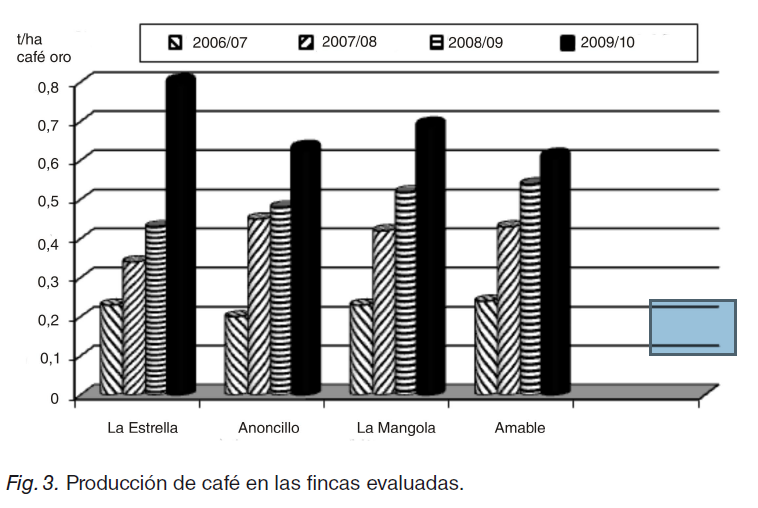
During February 2004-October 2009 period, the main problems that affect the coffee production were identified in four properties, planted with Coffea canephora Pierre ex Froehner species, in the Basic Unit of Cooperative Production June 14, of the Filé community, Tercer Frente, Santiago de Cuba province. Starting from a diagnosis; a development program settled down that included the application of appropriate technologies according to each case. The good physiologic state of the plantations was observed with more than 20 years of age and a depopulation that it oscillated between the 10 and 35 % of the coffees. Among the arboreal species not appropriate for the development of the cultivation the most frequent were Guasuma tomentosa, H. B. K. with 65 %, Manguifera indica L. and Roystonea regia Cook. V with 53 %, respectively. The most abundant were Musa paradisiaca L., Gliricidia sepium and Samanea saman Jerr. with 1362, 265 and 152 trees, respectively. In the evaluated properties sustained increments of the yields were achieved among 0.32 and 0.69 t/ha-1 of coffee gold during the crop 2009/2010. In the social order, it was determined that the relationship men/nucleus was 1.9, men linked to the cultivation 2.59, high incorporation of the woman to the work, insufficient cultural activities, 76 % of satisfaction for the housing in areas of the entity and 23 % of the activities to the insufficient coffee. They were carried out training activities in thematic of interest for the integral development of the entity, the producers and their relatives.
Article Details

This work is licensed under a Creative Commons Attribution-NonCommercial 4.0 International License.
Those authors who have publications with this journal accept the following terms of the License Attribution-NonCommercial 4.0 International (CC BY-NC 4.0):
You are free to:
- Share — copy and redistribute the material in any medium or format
- Adapt — remix, transform, and build upon the material
The licensor cannot revoke these freedoms as long as you follow the license terms.
Under the following terms:
- Attribution — You must give appropriate credit, provide a link to the license, and indicate if changes were made. You may do so in any reasonable manner, but not in any way that suggests the licensor endorses you or your use.
- NonCommercial — You may not use the material for commercial purposes.
- No additional restrictions — You may not apply legal terms or technological measures that legally restrict others from doing anything the license permits.
The journal is not responsible for the opinions and concepts expressed in the works, they are the sole responsibility of the authors. The Editor, with the assistance of the Editorial Committee, reserves the right to suggest or request advisable or necessary modifications. They are accepted to publish original scientific papers, research results of interest that have not been published or sent to another journal for the same purpose.
The mention of trademarks of equipment, instruments or specific materials is for identification purposes, and there is no promotional commitment in relation to them, neither by the authors nor by the publisher.
How to Cite
References
Cabrera, M.; López, C.; Portilla, M.; Díaz, W. y C. Bustamante: Descripción de clones de C. canephora en el Tercer Frente. Café Cacao, 1(1): 23 - 29, 1998.
Cifuentes, L. E.: Competitividad y calidad en armonía con la naturaleza. En: Panel de Caficultura Sostenible XVIII Simposio Latinoamericano de Caficultura. -- Costa Rica: Icafé IICA, pp. 100-119, 1997.
Martínez y col.: Prospección tecnológica de la Cadena Productiva del café en Cuba.-- Minag-Ecicc, 52 pp. 2001.
Minag. Ministerio de la Agricultura, Cuba: Instrucciones
Técnicas para el cultivo del café y cacao. CIDA La Habana, 208 pp., 1987.
______: Programa Nacional de Medio Ambiente y Desarrollo. -- La Habana: Citma, --116 pp., 1995.
______: Propuesta preliminar para la organización del Sistema de Extensión Agraria. -- CIDA La Habana, 17 pp., 2003.
______: Manual para la Extensión Agrícola en Café y Cacao.-- CIDA La Habana, Tercera edición, 47 pp., 2008.
______: Desarrollo Integral de Café, Cacao y Apicultura. Desarrollo, Negocios e Inversiones. - - La Habana, GEAM. 17 pp., 2010.
Molina-A., G.; Díaz-H., W.; Vázquez-L., E. y R. Reyes-G.: Comportamiento de los rendimientos de cafetos C. canephora Pierre ex Froehner sometido a poda de recepa y manejo intensivo de sombra. Café Cacao, 7 (2): 19-21, 2006.
Ronquillo, R.: “El Café”. Juventud Rebelde No. 382, p. 4, [en prensa], diciembre de 1997.