Influence of good agrotechnical practices on results productive plants of the UBPC coffee-growing Followers of Che
Article Sidebar
Main Article Content
Abstract
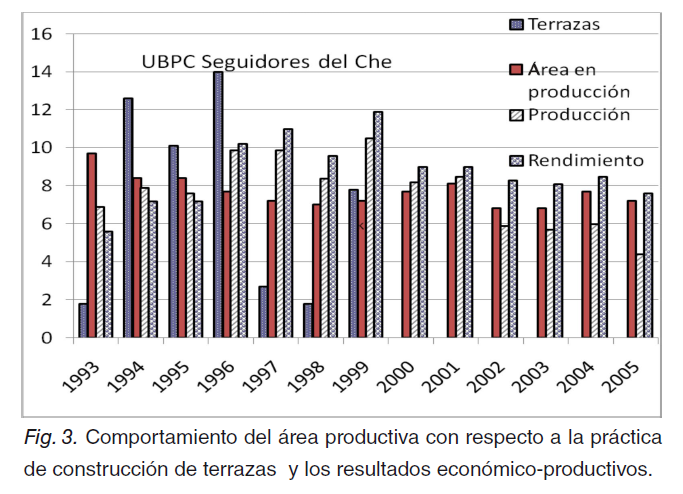
The work began with the field data compilation in the period 1993-2006 in all the labors made in the Coffee plantation UBPC “Seguidores del Che”; inside those that those were selected with enough systematical for its comparison carried out by means of the percentage referred to the higher value observed, with the objective of checking the influence of the nice agrotechnical practices in the productive results of the coffee plantation UBPC “Seguidores del Che”. As a result of the work the importance was appreciated of each one of the agrotechnical activities, to which were applied an analysis of simple correlation in connection with the obtained yield that it showed a positive relationship (r = 0.73), for the construction of continuous terraces, fundamentally in the moment of the sowing that it influenced largely in the obtaining of high yields in this UBPC.
Article Details

This work is licensed under a Creative Commons Attribution-NonCommercial 4.0 International License.
Those authors who have publications with this journal accept the following terms of the License Attribution-NonCommercial 4.0 International (CC BY-NC 4.0):
You are free to:
- Share — copy and redistribute the material in any medium or format
- Adapt — remix, transform, and build upon the material
The licensor cannot revoke these freedoms as long as you follow the license terms.
Under the following terms:
- Attribution — You must give appropriate credit, provide a link to the license, and indicate if changes were made. You may do so in any reasonable manner, but not in any way that suggests the licensor endorses you or your use.
- NonCommercial — You may not use the material for commercial purposes.
- No additional restrictions — You may not apply legal terms or technological measures that legally restrict others from doing anything the license permits.
The journal is not responsible for the opinions and concepts expressed in the works, they are the sole responsibility of the authors. The Editor, with the assistance of the Editorial Committee, reserves the right to suggest or request advisable or necessary modifications. They are accepted to publish original scientific papers, research results of interest that have not been published or sent to another journal for the same purpose.
The mention of trademarks of equipment, instruments or specific materials is for identification purposes, and there is no promotional commitment in relation to them, neither by the authors nor by the publisher.
How to Cite
References
Altieri, M. y A. Yurjevic: La agroecología y el desarrollo rural sostenible en América Latina. pp. 1-15, 2000.
Astier Martha: Hacia la recuperación de la vida en el suelo. Leisa, 18 (3): 15-16, 2002.
Caballero, R.; Baño, N.; Cabrera, E.; Simón, J. y A. Hernández: ¿Quién me vende 50 camiones de tierra? Una experiencia haitiano-cubana de rehabilitación de suelos. Leisa 19 (4): 21–23, 2004.
Cabrera, Mireya: “Sistema de extensión agraria en plantaciones cafetaleras del Tercer Frente, Santiago de Cuba”. [inédito], tesis de candidatura. Universidad Agraria de La Habana. Centro de Estudios de Agricultura Sostenible, 100 pp., Guantánamo, 2002.
Cárdenas, H.: Fincas Integrales y el proceso de transición en Costa Rica, 18 Casos. Leisa, 22 (2): 5-8, 2006.
Caro, P.: Perfil de la producción de café ecológico en Cuba. Agricultura Orgánica, (1): 12-13, 2004.
Critchley, W. y Marit Beommer: Comprendiendo las tierras degradables. Leisa, 19 (4): 21-31, 2004.
Delgadillo, P. J. y F. Delgado B.: Evaluación de la implementación de conservación de suelos: el caso de la comunidad Chullpa K’asa, Ocho estudios de caso, Bolivia. Leisa, Edición especial, pp. 24-31, 2004.
Martínez, M. y N. Bakker: De campesino a campesino en el norte de Mozambique. Leisa, 22 (3): 9-11, 2006.
Sandy, C.; Frías, R. y F. Delgado: Estudio de indicadores de sostenibilidad del sistema familiar campesino en ecosistema de montaña: el caso de la comunidad de Tres Cruces. Edición especial. Ocho estudios de caso, Bolivia. Leisa, pp. 32-38, 2004.