Effect of Codafol® application on the production of Coffea arabica L. seedlings
Article Sidebar
Main Article Content
Abstract
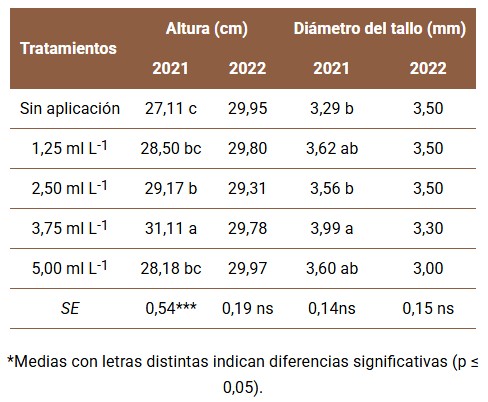
The production of high-quality coffee seedlings in nurseries is crucial for the successful establishment of new plantations and the future productivity of the crop. To evaluate the growth and development response of Coffea arabica L. seedlings to the application of different concentrations of Codafol®, a study was conducted in a nursery in Holguín Province, Cuba, over two growing seasons (2020-2021 and 2021-2022). A completely randomized design with five treatments and ten replicates was used, consisting of the foliar application of four concentrations of Codafol® (1.25, 2.50, 3.75, and 5.00 ml L⁻¹) and a control without application. Morphological indicators such as height, stem diameter, shoot and root dry weight, leaf area, and Dickson quality index were evaluated. The results showed that foliar fertilization with Codafol® exerted a generally beneficial effect. Significant increases were observed in shoot dry mass (up to 30.1%), root dry mass (up to 33%), and total dry mass (up to 29.9%), as well as in leaf area, in the treated plants compared to the control. The Dickson quality index was also higher in the Codafol® treatments. Using a rectilinear discontinuity model applied to leaf area, the optimal concentration was determined to be 2.50 ml L⁻¹. It is concluded that the application of Codafol® is an effective agronomic practice for optimizing seedling morphology and quality, with the 2.50 ml L⁻¹ dose being the most recommended as it induces the best overall results for transplanting.
Article Details

This work is licensed under a Creative Commons Attribution-NonCommercial 4.0 International License.
Those authors who have publications with this journal accept the following terms of the License Attribution-NonCommercial 4.0 International (CC BY-NC 4.0):
You are free to:
- Share — copy and redistribute the material in any medium or format
- Adapt — remix, transform, and build upon the material
The licensor cannot revoke these freedoms as long as you follow the license terms.
Under the following terms:
- Attribution — You must give appropriate credit, provide a link to the license, and indicate if changes were made. You may do so in any reasonable manner, but not in any way that suggests the licensor endorses you or your use.
- NonCommercial — You may not use the material for commercial purposes.
- No additional restrictions — You may not apply legal terms or technological measures that legally restrict others from doing anything the license permits.
The journal is not responsible for the opinions and concepts expressed in the works, they are the sole responsibility of the authors. The Editor, with the assistance of the Editorial Committee, reserves the right to suggest or request advisable or necessary modifications. They are accepted to publish original scientific papers, research results of interest that have not been published or sent to another journal for the same purpose.
The mention of trademarks of equipment, instruments or specific materials is for identification purposes, and there is no promotional commitment in relation to them, neither by the authors nor by the publisher.
How to Cite
References
Abdelsalam, N. R., Kandil, E. E., Al-Msari, M. A. F., Al-Jaddadi, M. A. M., Ali, H. M., Salem, M. Z. M., & Elshikh, M. S. (2019). Effect of foliar application of NPK nanoparticle fertilization on yield and genotoxicity in wheat (Triticum aestivum L.). Science of The Total Environment, 653, 1128-1139. https://doi.org/10.1016/j.scitotenv.2018.11.023.
Álvarez, J. L. y Damião, J. C. (2018). Producción de posturas de café con la aplicación de microorganismos eficientes en Angola. Rev. Centro Agrícola. 45(2):29-33. http://scielo.sld.cu/scielo.php?script=sci-arttext&pid=S0253-57852018000200004.
Alves Pereira, R., Gomes Júnior, G. A., Rodrigues, E. M., Sodré, G. A., & Sacramento, C. K. do. (2018). Manejo de matrizes interfere no rendimento e na qualidade de mudas de cacaueiros. Revista Brasileira de Fruticultura, 40(3), 1-8. https://doi.org/10.1590/0100-29452018582.
Ashouri Vajari, M., Fatahi Moghadam, J., & Eshghi, S. (2018). Influence of late season foliar application of urea, boric acid and zinc sulfate on nitrogenous compounds concentration in the bud and flower of Hayward kiwifruit. Scientia Horticulturae, 242, 137-145. https://doi.org/10.1016/j.scienta.2018.07.029.
Barreto, G., Petry, C., Silveira, D., Trentin, T., Turmina, A. P., & Chiomento, J. L. T. (2023). Uso de bioestimulantes en el manejo sustentable de cultivos frutales: una revisión narrativa. Latin American Developments in Energy Engineering, 4(1): 29-48. https://doi.org/10.17981/ladee.04.01.2023.3.
Barrios, M. B., Buján, A., Debelis, S. P., Sokolowski, A. C., Blasón, Á. D., Rodríguez, H. A., López, S. C., De Grazia, J., Mazo, C. R., Gagey, M. C., Barrios, M. B., Buján, A., Debelis, S. P., Sokolowski, A. C., Blasón, Á. D., Rodríguez, H. A., López, S. C., De Grazia, J., Mazo, C. R., & Gagey, M. C. (2014). Relación de raíz/biomasa total de Soja (Glycine max) en dos sistemas de labranza. Terra Latinoamericana, 32(3), 221-230.
Basave-Villalobos, E., Cetina-Alcalá, V. M., López-López, M. Á., Trejo, C., Ramírez-Herrera, C., Conde-Martínez, V., Basave-Villalobos, E., Cetina-Alcalá, V. M., López-López, M. Á., Trejo, C., Ramírez-Herrera, C., & Conde-Martínez, V. (2020). Fertilización de Pithecellobium dulce (Roxb.) Benth en vivero: Efectos en la calidad de planta. Madera y bosques, 26(3). https://doi.org/10.21829/myb.2020.2632059.
Bustamante, C.A.; Ferrás, Y. ; Sánchez, O.; Viñals, R. & Pérez, J.A. (2018). Respuesta de variedades de Coffea arabica L. a la aplicación de FitoMas-E en dos suelos cubanos. Café Cacao 17(1):15-25.ISSN: 1680-7685.
Bustamante, C.A.; Viñals, R. & Ferrás, Y. (2019). Efecto de concentraciones de FitoMas-E en el crecimiento de plántulas de Coffea arabica L. Café Cacao 18(2):40-47. ISSN: 1680-7685.
Bustamante, C.A.; Vázquez, Y.; Fernández, I. & Ferrás, Y. (2023). Effects of different VIUSID Agro concentrations on the growth of Coffea arabica L. seedlings. Agro Productividad 16(7):79-87. https://doi.org/10.32854/agrop.v16i7.2522.
Cargua Chávez, J., Echeverria Arangundi, C. M., & Cedeño García, G. A. (2020). Efectividad de biochar y biofertilizantes en el crecimiento y calidad de plántulas de cacao. Revista ESPAMCIENCIA, 11(2), 95-100.
Cargua Chávez, J., Luna Tamayo, A. K., González Sanango, H., Cedeño García, G. A., Cedeño Sacón, Á. F., Cargua Chávez, J. E., Luna Tamayo, A. K., González Sanango, H., Cedeño García, G. A., & Cedeño Sacón, Á. F. (2022). Crecimiento y calidad de plantas de café arábica con la aplicación de biochar y biofertilizantes en vivero. Chilean journal of agricultural & animal sciences, 38(1), 3-14. https://doi.org/10.29393/chjaas38-lccja50001.
Canseco, M. D.A.; Villegas, A.Y.; Castañeda, H. E.; Robles, C.P.; Carrillo, R.J.C. & Santiago, M.G.M. (2020). Respuesta de Coffea arabica L. a la aplicación de abonos orgánicos y biofertilizantes. Rev. Mex. Cienc. Agríc. 11(614):1285-1298. https://www.scielo.org.mx/pdf/remexca/v11n6/2007-0934-remexca-11-06-1285.pdf.
Carvajal, J. F. (1984). Cafeto. Cultivo y fertilización. (Berna) (2a ed.). Instituto Internacional de la Potasa.
Castillo, J.; Fornaris, A.A. & Hechavarría, J. (2022). Efecto de cuatro fertilizantes foliares sobre el rendimiento y calidad del tomate (Solanum lycopersicum L.) (en línea). Ciencia en su PC 1(2):1-4, https://www.redalyc.org/journal/1813/181373019009/html/
CENICAFE. (2013). Manual del cafetero colombiano: II (Centro Nacional de Investigaciones de Café). Federación Nacional de cafeteros de Colombia.
Clemente, J. M., Martinez, H. E. P., Pedrosa, A. W., Poltronieri Neves, Y., Cecon, P. R., & Jifon, J. L. (2018). Boron, Copper, and Zinc Affect the Productivity, Cup Quality, and Chemical Compounds in Coffee Beans. Journal of Food Quality, 2018(1), 7960231. https://doi.org/10.1155/2018/7960231.
Díaz Medina, A., Carrillo González, A. & Suárez Pérez, C. (2023). Efecto de bioproductos sobre el desarrollo de posturas de café en vivero. Revista Mexicana de Ciencias Agrícolas 14 (4): 495-505. https://doi.org/10.29312/remexca.v14i4.3303.
Dickson, A., Leaf, A., & Hosner, J. (1960). Quality appraisal of white spruce and white pine seedling stock in nurseries. The Forestry Chronicle, 36, 10-13.
Espinoza, R. J., Ortiz, J., Mendoza, M. D. C., Villegas, A., Peña, C., Almaguer, G., & Villaseñor, J. A. (1998). Modelo de regresión para la estimación de peso fresco y seco de ramas de durazno (Prunuspersica). Revista Chapingo Serie horticultura, 4(2), 125-131.
Ferrás, Y.; Bustamante, C.A. & Pérez, P. (2023). Respuesta de posturas de café a la aplicación foliar de un bioestimulador (en línea). Ingeniería Agrícola 1(3) e05 https://www.redalyc.org/journal/5862/586275623005/html/
Ferrás, Y.; Bustamante, C.A. & Pérez, V. (2024). Ciclos de aplicación de un bioestimulante sobre el desarrollo de plantas de café en vivero. Agronomía Costarricense 48(2): 143-149. ISSN 2215-2202 https://www.mag.go.cr/rev_agr/index.html
García-Alzate, J., Benavides-Cardona, C. A., & Álvarez-Sánchez, D. E. (2022). Aplicación de urea, DAP Y KCL sobre almácigos de café (Coffa arabica L.) de la variedad Castillo. Revista de Investigación Agraria y Ambiental, 13(1), 33-49, ISSN: 2145-6097. https://hemeroteca.unad.edu.co/index.php/riaa/article/view/4297/5257
González Ulibarry, P. (2019). Fertilizantes foliares. Generalidades. Biblioteca del Congreso Nacional de Chile. Asesoría Técnica Parlamentaria. https://obtienearchivo.bcn.cl/obtienearchivo?id=repositorio/10221/27247/1/Fertilizantes_Foliares.pdf.
González-Fernández, C., Ferrás-Negrín, Y., Meneses-Zamora, I., & Ortiz-Gómez, N. (2017). Efecto del humus de lombriz en sustratos para la producción de posturas de cafeto en suelo Ferralítico Lixiviado ácido. Café Cacao, 16(2), 27-32.
Grossnickle, S. C., & MacDonald, J. E. (2018). Seedling Quality: History, Application, and Plant Attributes. Forests, 9(5), 283. https://doi.org/10.3390/f9050283.
Hernández Jiménez, A., Pérez Jiménez, J. M., Bosh Infante, D., & Castro Speck, N. (2015). Clasificación de los suelos de Cuba 2015. INSTITUTO NACIONAL DE CIENCIAS AGRÍCOLAS. INSTITUTO DE SUELOS.
Hubel. (2017). Ficha Técnica de Producto: CODAFOL 14-6-5. Referencia: FC-0050A. Grupo Hubel Verde.
INAF. (2013). Instructivo Técnico Café Arábico (Instituto de Investigaciones Agro Forestales). Ministerio de la Agricultura.
InfoStat. (2001). InfoStat versión 1.0 [Software]. Universidad Nacional de Córdova, Argentina.
Li, J., Liu, H., Wang, H., Luo, J., Zhang, X., Liu, Z., Zhang, Y., Zhai, L., Lei, Q., Ren, T., Li, Y., & Bashir, M. A. (2018). Managing irrigation and fertilization for the sustainable cultivation of greenhouse vegetables. Agricultural Water Management, 210, 354-363. https://doi.org/10.1016/j.agwat.2018.08.036.
Loeza-Lara, P., Jiménez-Mejía, R., & Santoyo, G. (2024). El efecto de los bioestimulantes en cultivos hortícolas.Horticulturae, 10 (10), 1086. https://doi.org/10.3390/horticulturae10101086.
Mosa, W.F.A.; Sas-Paszt, L.; Głuszek, S.; Górnik, K.; Akbar Anjum, M.; Saleh, A.A.; Abada, H.S. & Awad, R.M. (2023). Effect of Some Biostimulants on the Vegetative Growth, Yield, Fruit Quality Attributes and Nutritional Status of Apple. Horticulturae, 9, 32. https://doi.org/10.3390/horticulturae9010032.
Orozco A., M., & Calvo Araya, J. A. (2019). Consideraciones técnicas para la preparación de abonos foliares de fabricación casera. Revista Pensamiento Actual, 19(33), 106-120. https://doi.org/10.15517/pa.v19I33.39636.
Puppe, D., & Acosta, M. (2018). Experiments, Uptake Mechanisms, and Functioning of Silicon Foliar Fertilization-A Review Focusing on Maize, Rice, and Wheat. En Advances in Agronomy (Vol. 152, pp. 1-49). Academic Press. https://doi.org/10.1016/bs.agron.2018.07.003.
Rivera, R., Martín, G. M., Simó, J. E., Pentón, G., García-Rubido, M., Ramírez, J., J, G. P., Joao, J. P., Ojeda, L., Tamayo, Y., & Bustamante, C. (2020). Benefits of joint management of green manure and mycorrhizal inoculants in crop production. Tropical and subtropical Agroecosystems, 23(3), Article 97.
Rossi, L., Fedenia, L. N., Sharifan, H., Ma, X., & Lombardini, L. (2019). Effects of foliar application of zinc sulfate and zinc nanoparticles in coffee (Coffea arabica L.) plants. Plant Physiology and Biochemistry, 135, 160-166. https://doi.org/10.1016/j.plaphy.2018.12.005.
Sadeghian, S., & Ospina, C. (2021). Manejo nutricional de café durante la etapa de almácigo. Avances Técnicos Cenicafe, 532, 1-8.
Salamanca, A., & González-Osorio, H. (2020). Respuesta del café a la aplicación foliar de nutrientes. Revista Cenicafé, 71(2), 124-142. https://doi.org/10.38141/10778/71210.
Sampaio Silveira, S., Posse, R. P., da Silva, S. M. F., de Souza Oliveira, V., Valani, F., Partelli, R. L., de Moura Trindade, I., Souza, C. A. S., Posse, S. C. P., & Costa, G. S. (2019). Growth and quality of genotype ps-1319 cacao seedlings produced under different irrigation depths. Journal of Agricultural Science, 11(16), 238-247.
Shahzad, M.; Hayat, R.; Mujtaba, G.; Ur Rehman, W. & Nadeem, M. (2025). Biofertilizers in sustainable agriculture: mechanisms, applications, and future prospects.Discov Agric3, 224. https://doi.org/10.1007/s44279-025-00318-0.
Sheng, F., Gao, K., Hu, W., Wang, S., Chen, B., & Zhou, Z. (2019). Foliar and seed application of plant growth regulators affects cotton yield by altering leaf physiology and floral bud carbohydrate accumulation. Field Crops Research, 231, 105-114.
Soto, F. (1980) Estimación del área foliar en C. arabica L. a partir de las medidas lineales de las hojas. Cultivos Tropicales, 2(3): 115-128.
van Noordwijk, M., & Willigen, P. de. (1987). Agricultural concepts of roots: From morphogenetic to functional equilibrium between root and shoot growth. Netherlands Journal of Agricultural Science, 35(4), 487-496. https://doi.org/10.18174/njas.v35i4.16707.
Valverde, Y.L.; Moreno, J.Q.; Quijije, K.Q.; Castro, A.L.; Merchán, W. G. & Gabriel, J.O. (2020). Los bioestimulantes: una innovación en la agricultura para el cultivo del café (Coffea arabica L.). J. SelvaAndina Res.Soc.11(1):18-28. http://www.scielo.org.bo/scielo.php?pid=S2072-92942020000100003&script=sci-arttext.
Viñals-Núñez, R., Bustamante-González, C. A., Ramos-Hernández, R., Sánchez-Durán, O., Moran-Rodríguez, N., & Ferrás-Negrín, Y. (2017). Empleo de bioproductos en la producción de posturas de Coffea arabica L. Café Cacao, 16(1), 35-43.
Waugh, D. L., Cate, R. B., & Nelson, L. A. (1972). Modelos discontinuos para una rápida correlación, interpretación y utilización de los datos de análisis de suelo y la respuesta a la fertilización (No. 7; p. 106). Proyecto Internacional de Evaluación y Mejoramiento de la Fertilidad del Suelo. North Carolina State University.