Influence of physical-chemical properties of substrates in the development of Coffea arabica L. seedling
Article Sidebar
Main Article Content
Abstract
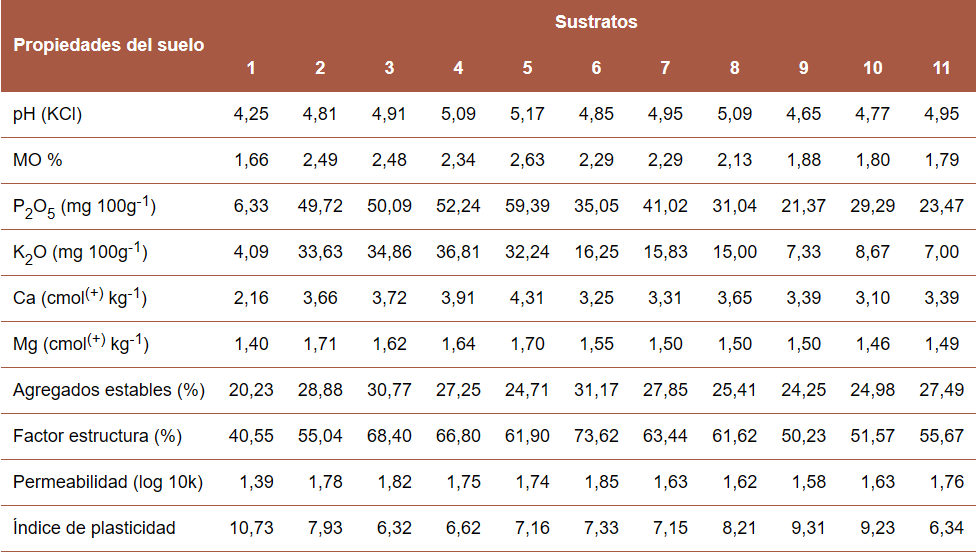
The study of the physicochemical properties of substrates is crucial for optimizing seedling production of Coffea arabica, given their impact on plant growth and quality. This study evaluated the influence of these properties on seedling development in a Leached Red Ferralitic soil from Topes de Collantes, Cuba. Substrates with varying physicochemical characteristics (organic matter, pH, phosphorus, permeability, stable aggregates) were used, and agrobiological indicators such as leaf area, root dry mass, and quality index were measured. The results showed that physical properties, especially stable aggregates (correlation of 0.91*** with root dry mass), had a greater influence than chemical properties. Organic matter, P₂O₅, and pH also correlated significantly with leaf area (0.69, 0.64, 0.63*, respectively). It was concluded that substrates with high structural stability, permeability, and a low plasticity index favor root development and seedling vigor, highlighting the importance of integrating both types of properties to improve nursery production.
Article Details

This work is licensed under a Creative Commons Attribution-NonCommercial 4.0 International License.
Those authors who have publications with this journal accept the following terms of the License Attribution-NonCommercial 4.0 International (CC BY-NC 4.0):
You are free to:
- Share — copy and redistribute the material in any medium or format
- Adapt — remix, transform, and build upon the material
The licensor cannot revoke these freedoms as long as you follow the license terms.
Under the following terms:
- Attribution — You must give appropriate credit, provide a link to the license, and indicate if changes were made. You may do so in any reasonable manner, but not in any way that suggests the licensor endorses you or your use.
- NonCommercial — You may not use the material for commercial purposes.
- No additional restrictions — You may not apply legal terms or technological measures that legally restrict others from doing anything the license permits.
The journal is not responsible for the opinions and concepts expressed in the works, they are the sole responsibility of the authors. The Editor, with the assistance of the Editorial Committee, reserves the right to suggest or request advisable or necessary modifications. They are accepted to publish original scientific papers, research results of interest that have not been published or sent to another journal for the same purpose.
The mention of trademarks of equipment, instruments or specific materials is for identification purposes, and there is no promotional commitment in relation to them, neither by the authors nor by the publisher.
How to Cite
References
Agustí, M. (2010). Fruticultura. Ediciones Mundi-Prensa. https://books.google.es/books?hl=es&lr=&id=aawSAQAAQBAJ&oi=fnd&pg=PA3&dq=Fruticultura+&ots=OeNXmXvi4e&sig=zjsBFwzvsXnhTFQlUiE7DBf831A
Arcila, J. (2007a). Crecimiento y desarrollo de la planta de café. En J. Arcila, F. Farfán, A. Moreno, L. Salazar, & E. Hincapié (Eds.), Sistemas de producción de café en Colombia. https://biblioteca.cenicafe.org/handle/10778/720
Arcila, J. (2007b). Establecimiento del cafetal. En J. Arcila, F. Farfán, A. Moreno, L. Salazar, & E. Hincapié (Eds.), Sistemas de producción de café en Colombia (pp. 87-100). https://www.cenicafe.org/es/documents/LibroSistemasProduccionCapitulo4.pdf
Arcila, J. (2007c). Factores que determinan la productividad del cafetal. En J. Arcila, F. Farfán, A. Moreno, L. Salazar, & E. Hincapié (Eds.), Sistemas de producción de café en Colombia. https://biblioteca.cenicafe.org/handle/10778/720
Cairo, P. (2000). Alternativas para el mejoramiento de los suelos para el cultivo de la caña. Agricultura Orgánica, 14(2), 23-25.
Cairo, P., & Álvarez, U. (2017). Efecto del estiércol en el suelo y en el cultivo de la soya Glycine max (L.) Merr. Pastos y forrajes, 40(1), 37-42.
Campoy, M. J. (2015). Efecto de las acciones antrópicas sobre la estabilidad de agregados del suelo en zonas semiáridas [PhD Thesis, Universidad de Murcia]. https://dialnet.unirioja.es/servlet/tesis?codigo=99902
Di Rienzo, J. A., Casanoves, F., Balzarini, M. G., Gonzalez, L., Tablada, M., & Robledo, C. W. (2014). InfoStat versión 2014. InfoStat Group, Facultad de Ciencias Agropecuarias, Universidad Nacional de Córdoba, Argentina. URLhttp://www.infostat.com.ar
Díaz, W., Caro, P., Bustamante, C., Sánchez, C., Rodríguez, M., & Vázquez, E. (2013). Instructivo Técnico Café Arábico (Coffea arabica Lin). Instituto de Investigaciones Agro-Forestales: Ministerio de la Agricultura. Dirección de Café y Cacao del Grupo Empresarial de Agricultura de Montaña. Instituto de Investigaciones Agro-Forestales, 138.
Dickson, A., Leaf, A. L., & Hosner, J. F. (1960). QUALITY APPRAISAL OF WHITE SPRUCE AND WHITE PINE SEEDLING STOCK IN NURSERIES. The Forestry Chronicle, 36(1), 10-13. https://doi.org/10.5558/tfc36010-1
Falcón, E., Riera Nelson, M. C., & Rodríguez Leyva, O. (2013). Efecto de la inoculación de hongos micorrizógenos sobre la producción de posturas forestales en dos tipos de suelos. Cultivos Tropicales, 34(3), 32-39.
Ferrás, Y. (2016). Influencia de compuestos organominerales en las propiedades físico-químicas de sustratos y el desarrollo de posturas de cafeto [Tesis para optar por el título de máster]. Universidad Sancti Spíritus, José Martí Pérez.
Hernández, A., Pérez, J. M., Bosch, D., & Castro, N. (2015). Clasificación de los Suelos de Cuba. INCA.
Meléndez, G. (2012). Evaluación de las propiedades fisicas de un suelo cultivado con caña de azucar (Saccharum officinarum) bajo la aplicación de biosolidos [Trabajo de titulación]. Universidad del Valle. Facultad de Ingeniería, Santiago de Cali.
NC 52. (1999). Norma cubana 52: Calidad del suelo. Determinación de las formas móviles de fósforo y potasio. (p. 12). Comité Técnico de Normalización No 3.
NC 65. (2000). Norma cubana 65: Calidad del suelo. Determinación de la capacidad de intercambio catiónico y de los cationes del suelo. (p. 10). Comité Técnico de Normalización No 3.
NC ISO 10390. (1999). Norma cubana ISO 10390: Calidad del suelo. Determinación del pH. (p. 11). Comité Técnico de Normalización No 3.
NRAG 279. (1980). Norma Ramal de la Agricultura 279-80. Suelos. Análisis químico. Reglas generales. (p. 54). MINAG.
Salamanca, A., & Sadeghian, S. (2008). Almácigos de café con distintas proporciones de lombrinaza en suelos con diferente contenido de materia orgánica. Cenicafé, 59(2), 91-102.
Sánchez, P. A., & Camacho, E. (1981). Suelos del trópico: Características y manejo. IICA Biblioteca Venezuela. https://books.google.es/books?hl=es&lr=&id=20MMFDtmtGAC&oi=fnd&pg=PA103&dq=Suelos+del+tr%C3%B3pico:+Caracter%C3%ADsticas+y+manejo&ots=OV1p12oxK5&sig=Gjvrh3P7x9DsMdhNa2x0_pz0Ick
Soto, F. (1980). ESTlMAClON DEL AREA FOLIAR EN C. arabica L. A PARTIR DE LAS MEDIDAS LINEALES DE LAS HOJAS. Cultivos tropicales, 2(3), Article 3.
Torres, C. A., Etchevers, J. D., Fuentes-Ponce, M. H., Govaerts, B., León-González, F. D., & Herrera, J. M. (2013). Influencia de las raíces sobre la agregación del suelo. Terra latinoamericana, 31(1), 71-84.