Characterization of the oligochaetefauna associated with a coffee ecosystem in Topes de Collantes in dry months
Article Sidebar
Main Article Content
Abstract
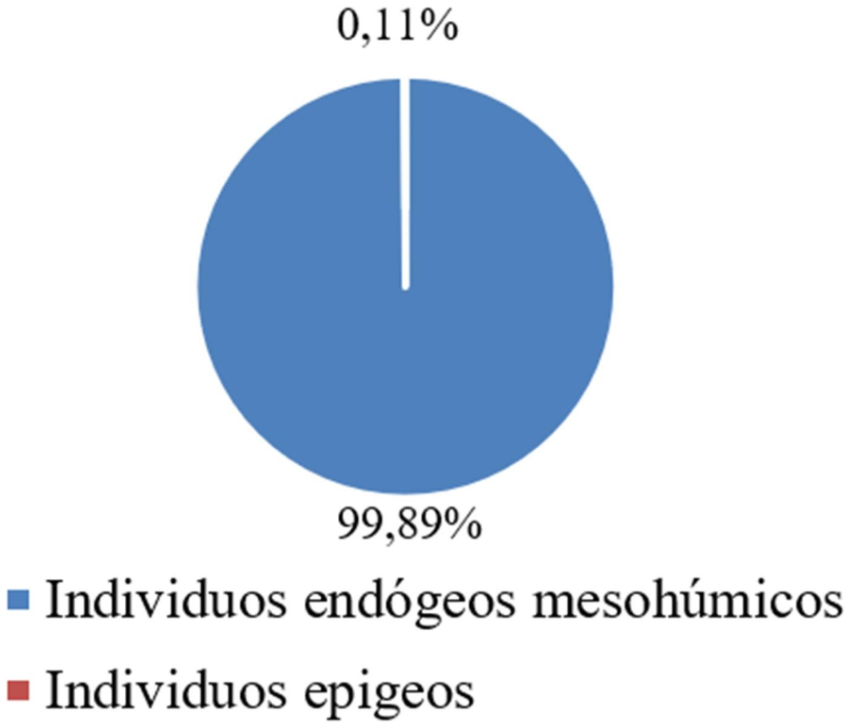
Oligochaete diversity in agricultural soils is crucial for ecosystem health, as these organisms improve soil fertility and structure. This study aimed to characterize the oligochaetofauna in a shaded coffee plantation in Topes de Collantes, Cuba, during dry months (December 2003-March 2004). A total of 887 individuals were collected using stratified soil monoliths (25 × 25 × 30 cm) following the TSBF protocol and taxonomically identified. The results showed three exotic species (families Glossoscolecidae and Megascolecidae), dominated by Pontoscolex corethrurus (99.77% abundance), categorized as mesohumic endogeic. Density (354 ind m⁻²) and biomass (80.25 g m⁻²) were highest in the top 10 cm of soil, associated with high organic matter. It was concluded that the absence of native species reflects anthropogenic impact, while the shade of the guamo (Inga vera) favored biomass, supporting the role of oligochaetes as bioindicators of soil quality in agroecosystems.
Article Details

This work is licensed under a Creative Commons Attribution-NonCommercial 4.0 International License.
Those authors who have publications with this journal accept the following terms of the License Attribution-NonCommercial 4.0 International (CC BY-NC 4.0):
You are free to:
- Share — copy and redistribute the material in any medium or format
- Adapt — remix, transform, and build upon the material
The licensor cannot revoke these freedoms as long as you follow the license terms.
Under the following terms:
- Attribution — You must give appropriate credit, provide a link to the license, and indicate if changes were made. You may do so in any reasonable manner, but not in any way that suggests the licensor endorses you or your use.
- NonCommercial — You may not use the material for commercial purposes.
- No additional restrictions — You may not apply legal terms or technological measures that legally restrict others from doing anything the license permits.
The journal is not responsible for the opinions and concepts expressed in the works, they are the sole responsibility of the authors. The Editor, with the assistance of the Editorial Committee, reserves the right to suggest or request advisable or necessary modifications. They are accepted to publish original scientific papers, research results of interest that have not been published or sent to another journal for the same purpose.
The mention of trademarks of equipment, instruments or specific materials is for identification purposes, and there is no promotional commitment in relation to them, neither by the authors nor by the publisher.
How to Cite
References
Brinkhurst, R. O., & Jamieson, B. G. (1971). Aquatic Oligochaeta of the world. https://espace.library.uq.edu.au/view/UQ:5ab8d2b
Cairo, P. I., Machado, J., & Reyes, A. (2004). El guamo (Inga vera Willd) como control de la acidificación de los suelos en sistemas agroforestales bajo café. Centro Agrícola, 31(1), 118-120.
Di Rienzo, J. A., Casanoves, F., Balzarini, M. G., Gonzalez, L., Tablada, M., & Robledo, C. W. (2014). InfoStat versión 2014. InfoStat Group, Facultad de Ciencias Agropecuarias, Universidad Nacional de Córdoba, Argentina. URLhttp://www.infostat.com.ar
Domínguez, J., Aira, M., & Gómez-Brandón, M. (2009). El papel de las lombrices de tierra en la descomposición de la materia orgánica y el ciclo de nutrientes. Ecosistemas, 18(2), 20-31.
Gómez-Brandón, M. (2011). Efecto de las lombrices de tierra en la estructura y función de las comunidades microbianas en el proceso de descomposición de la materia orgánica. Ecosistemas, 20(1), 155-162.
Gutiérrez, B. (2003). Estudio preliminar de la oligoquetofauna asociada a un cafetal establecido en condiciones de montaña [Tesis para optar por el título de ingeniero en agronomía]. Facultad Agropecuaria de Montaña del Escambray, Universidad José Martí Pérez.
Hernández, A., Pérez, J. M., Bosch, D., & Castro, N. (2015). Clasificación de los Suelos de Cuba. INCA.
Huerta, E., Rodríguez-Olán, J., Evia-Castillo, I., Montejo-Meneses, E., De la Cruz-Mondragón, M., & García-Hernández, R. (2005). La diversidad de lombrices de tierra (Annelida, Oligochaeta) en el estado de Tabasco, México. Universidad y Ciencia, 21(42), 75-85.
Ingram, J., & Anderson, J. (1993). Tropical soil biology and fertility. A handbook of methods. 2nd ed. CAB Int., Wallingford, UK. https://courses.washington.edu/esrm304a/lectures/Soils/Tropical%20Soil%20Biology%20and%20Fertility%20Methods_Web%20Soils%20Reading.pdf
Kruskal, W. H., & and Wallis, W. A. (1952). Use of Ranks in One-Criterion Variance Analysis. Journal of the American Statistical Association, 47(260), 583-621. https://doi.org/10.1080/01621459.1952.10483441
Lavelle, P. (1997). Faunal activities and soil processes: Adaptive strategies that determine ecosystem function. En Advances in ecological research (Vol. 27, pp. 93-132). Elsevier. https://www.sciencedirect.com/science/article/pii/S0065250408600070
Luna, G., Sequeira, C., Torres, M., Taleno, E., Serrano, I., & González, M. (2010). Abundancia y biomasa de lombrices de tierra en dos ecosistemas intervenidos del bosque tropical húmedo, Bluefields. Ciencia e Interculturalidad: revista para el diálogo intercientífico e intercultural de, 6(1), 122-131.
Ramírez Pisco, R., Guzmán Álvarez, M. E., & Leiva Rojas, E. I. (2013). Dinámica de las poblaciones de lombrices en un Andisol sometido a distintos sistemas de uso del suelo. Revista Facultad Nacional de Agronomía Medellín, 66(2), 7045-7055.
Sánchez, S., & Hernández, M. (2011). Comportamiento de comunidades de lombrices de tierra en dos sistemas ganaderos. Pastos y Forrajes, 34(3), 359-365.
Sims, R. W. (1980). A Classification and the distribution of earthworms, suborder Lumbricina (Haplotascida: Oligochaeta). BULL. BR. MUS. (NAT. HIST.), 39(2), 124.
Vásquez Vela, A. L. M. (2014). Valoración comparativa de la macrofauna de lombrices en sistemas agroforestales de café orgánico y convencional en contraste con cultivos en pleno sol y bosque, durante la época lluviosa y seca en Turrialba, Costa Rica. https://agris.fao.org/search/en/providers/124212/records/6474af175eb437ddff72070c
Wallwork, J. A. (1976). The distribution and diversity of soil fauna.https://www.cabidigitallibrary.org/doi/full/10.5555/19761930270