Effect of doses of N, P, K and incorporation of Canavalia ensiformis as green fertilizer in the vegetative growth of Coffea canephora Pierre ex-Froehner
Article Sidebar
Main Article Content
Abstract
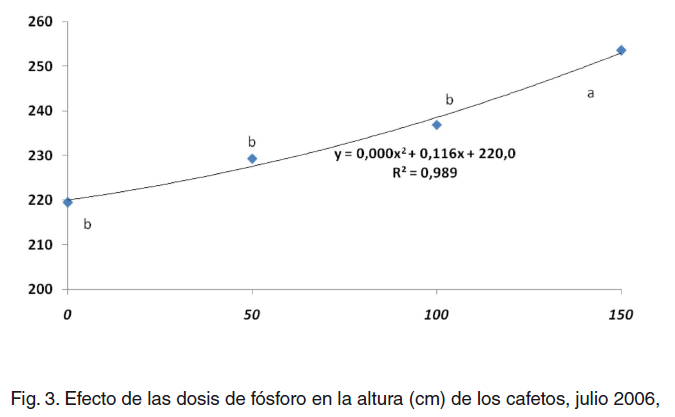
The investigation was executed in the Estación Central de Investigaciones de Café y Cacao, property The Mandarin located to 150 msnm in Tercer Frente municipality, Santiago de Cuba province, in a Brown soil of the Ochre subtype without carbonates. The study was carried out in a plantation of Coffea canephora Pierre ex Froehner pruned in the 2003, with the objective of knowing the effect of different N, P and K dosis and the incorporation of the Canavalia ensiformis like green manure, during morphologic development of the coffees; being evaluated the height of the plants and the cup diameter. The statistical analysis was corresponded with the used design. The nitrogen requirements for the vegetative growth of the species Coffea canephora, after being submitted to the low pruning were checked that they are of 50 kg of N/ha for the first year and 75 kg for the second year and for the third year 100 kg/ha, similar to the requirements of the species Coffea arabica. It was enough the application of 50 kg of P2O5/ha in the second year to guarantee the vegetative development of the coffees. In Brown soils with high contents of available potassium as the one used is not necessary the application of this element in the first year after the pruning while the application of 80 kg K2O/ha in the second year guarantees acceptable levels of growth of the coffee, the Canavalia ensiformis incorporate as green manure didn’t show significant effects in the evaluated indicators of growth.
Article Details

This work is licensed under a Creative Commons Attribution-NonCommercial 4.0 International License.
Those authors who have publications with this journal accept the following terms of the License Attribution-NonCommercial 4.0 International (CC BY-NC 4.0):
You are free to:
- Share — copy and redistribute the material in any medium or format
- Adapt — remix, transform, and build upon the material
The licensor cannot revoke these freedoms as long as you follow the license terms.
Under the following terms:
- Attribution — You must give appropriate credit, provide a link to the license, and indicate if changes were made. You may do so in any reasonable manner, but not in any way that suggests the licensor endorses you or your use.
- NonCommercial — You may not use the material for commercial purposes.
- No additional restrictions — You may not apply legal terms or technological measures that legally restrict others from doing anything the license permits.
The journal is not responsible for the opinions and concepts expressed in the works, they are the sole responsibility of the authors. The Editor, with the assistance of the Editorial Committee, reserves the right to suggest or request advisable or necessary modifications. They are accepted to publish original scientific papers, research results of interest that have not been published or sent to another journal for the same purpose.
The mention of trademarks of equipment, instruments or specific materials is for identification purposes, and there is no promotional commitment in relation to them, neither by the authors nor by the publisher.
How to Cite
References
Blanco, A.: “Manejo de la sombra en la regeneración de la variedad Robusta (Coffea canephora Pierre ex Froehner). Su influencia en el desarrollo vegetativo y la producción de café oro” [inédito], tesis de candidatura. INCA, La Habana, 2005.
Bustamante, C. y col.: Sistema de fertilización mineral y biofertilización de Coffea canephora Pierre ex Froehner cultivado en las condiciones de los macizos montañosos de la Sierra Maestra y Sagua-Nipe-Baracoa. En: Proyecto Nacional 046, Estación Central de Investigaciones de Café y Cacao, Tercer Frente, Santiago de Cuba, Informe final, 91 pp., 2002.
Bustamante, C. y G. Grave de Peralta: Producción de biomasa y retorno de nutrientes al ecosistema por Coffea canephora Pierre ex Froehner bajo diferentes sistemas de poda. En: XII Seminario Científico del INCA. Resúmenes, 2002.
Cardona, C. y K. Sadeghian: Ciclo de nutrimentos y actividad microbiana en cafetales a libre exposición solar y bajo sombrío de guamo (Inga spp). Cenicafé, 56(2): 127- 141, 2005.
Minag: Instrucciones Técnicas para el cultivo y la cosecha del café y el cacao. Ministerio de la Agricultura, 76 pp., La Habana, 1987.
Hernández, A. y col.: Nueva versión de clasificación genética de los suelos de Cuba. Agroinfor. Instituto de Suelos de La Habana. 64 pp., La Habana, 1999.
Kibirige-Ssebunya, I.; Nabasirye, M.; Matovu, J. and P. Musoli: A comparison among various Robusta coffee (Coffea canephora Pierre ex Froehner) clonal materials and their seedling progenies at different levels of nitrogen. Uganda Journal of Agricultural Science, 1(1): 5-12, 1993.
Kimemia, J. K.; Chweya, J. A.; y J. O. Nyabundi: The Effect of Green Manure application to Coffee Plants Growth, Yield and Quality in Kenya. In: Coloquium Scientific International. 18. Helsinki: ASIC, 1999.
Partielli, L.; Duarte, H. y F. Ribeiro: Cultivo com plantas de cobertura: alternativa viável. A lavoura, 112(671): 42-47, 2009.
Oliveira J.A.; Matiello, J. B.; Pinheiro, M. R. e R. Santinato: Primeiras observações sobre adubação NPK em cafetos Conilon en el Estado Rio de Janeiro. En: 8vo Congresso Brasileiro de Pesquissas Cafeeiras. Resumos. - Campos do Jordao: IBC. - pp. 395-398, 1980.
Ortiz, E.: Crecimiento y desarrollo del Coffea canephora Pierre variedad Robusta con diferentes marcos de plantación. Cultivos Tropicales, 14(1): 48-51,1993.
Pérez, A.; Bustamante, C.; Rodríguez, P. y R. Viñals: Influencia de la fertilización mineral sobre la microflora edáfica y algunos indicadores del crecimiento y productividad de Coffea canephora Pierre ex Froehner en un suelo Pardo. Cultivos Tropicales, 26(2): 65-72, 2005.
Rivera, R. y J. R. Martín: Efecto de niveles de N, P y K en Coffea arabica L. var. Mundo Novo cultivado al sol, sobre fondo fijo de arrope y compost en la fase de fomento. Parte II. Parámetros de crecimiento y rendimiento. Ciencia y Técnica en la Agricultura Serie Café y Cacao, 2(1):51-64, 1980.
Rivera R.: Crecimiento, nutrición la fertilización (NPK) del cafeto a plena exposición solar en suelos Ferralíticos Rojos. Cultivos Tropicales, 14(2-3): 5- 36, 1993.
Rivera, R. y col.: La fertilización nitrogenada del cafeto en diferentes condiciones edafoclimáticas de Cuba. Cultivos Tropicales, 15(1):5-11, 1994.
Rivera, R.: Nutrición y fertilización del Coffea arabica en Cuba. En: El cultivo del cafeto en Cuba. Investigaciones y Resultados, Informe de Proyecto, p. 500, 2006.
Snoeck, D.; Bitoga, J. P. y C. Barantwaririje: Avantages et Inconvénients de l’Utilisation des Divers Modes de Couverture dans les Caféières au Burundi. In: Coloquium Scientific International. 15. Montpellier:ASIC, 1993.