Effect of coconut fiber proportions and Multicote® doses on the development of coffee seedlings
Article Sidebar
Main Article Content
Abstract
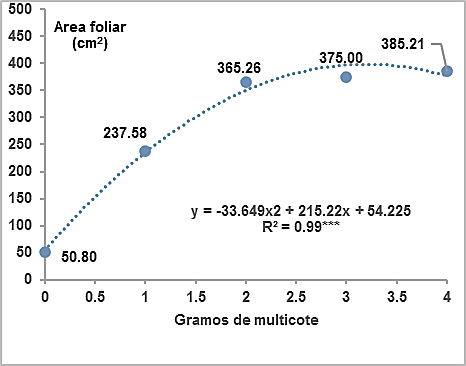
Coffee production in Cuba has experienced a significant decline in recent decades, with reductions in cultivated areas, production and yields. The lack of organic matter in mountainous regions for the production of coffee seedlings has prompted the search for sustainable alternatives, such as the use of coconut fiber and controlled-release fertilizers. The aim of the work was to evaluate the effect of different proportions of coconut fiber (CF) and doses of Multicote® fertilizer on the development of coffee seedlings in tubes. An experiment was carried out in a nursery in Villa Clara, Cuba, using a factorial design (5x5x1) with 26 treatments combining soil-CF proportions (0%, 25%, 50%, 75%, 100%) and doses of Multicote® (0, 1, 2, 3, 4 g/tube). Variables such as plant height, stem diameter, number of leaf pairs, leaf area and dry mass were evaluated. The treatment with 50% FC + 50% soil + 2 g of Multicote® showed the best results in height, stem diameter, total dry mass and leaf area, with no significant differences with the treatment of 50% FC + 50% soil + 3 g of Multicote®. The absence of Multicote® resulted in lower development of seedlings at all soil-FC ratios. The combination of 50% FC + 50% soil + 2 g of Multicote® is optimal for the development of coffee seedlings. Multicote® fertilizer is essential for the growth of seedlings, since substrates without it do not provide the necessary nutrients.
Article Details

This work is licensed under a Creative Commons Attribution-NonCommercial 4.0 International License.
Those authors who have publications with this journal accept the following terms of the License Attribution-NonCommercial 4.0 International (CC BY-NC 4.0):
You are free to:
- Share — copy and redistribute the material in any medium or format
- Adapt — remix, transform, and build upon the material
The licensor cannot revoke these freedoms as long as you follow the license terms.
Under the following terms:
- Attribution — You must give appropriate credit, provide a link to the license, and indicate if changes were made. You may do so in any reasonable manner, but not in any way that suggests the licensor endorses you or your use.
- NonCommercial — You may not use the material for commercial purposes.
- No additional restrictions — You may not apply legal terms or technological measures that legally restrict others from doing anything the license permits.
The journal is not responsible for the opinions and concepts expressed in the works, they are the sole responsibility of the authors. The Editor, with the assistance of the Editorial Committee, reserves the right to suggest or request advisable or necessary modifications. They are accepted to publish original scientific papers, research results of interest that have not been published or sent to another journal for the same purpose.
The mention of trademarks of equipment, instruments or specific materials is for identification purposes, and there is no promotional commitment in relation to them, neither by the authors nor by the publisher.
How to Cite
References
Balzarini, M. G., González, L., Tablada, M., Casanoves, F., Di Rienzo, J. A., & Robledo, C. W. (2008). Infostat. Manual del usuario (Primera). Editorial Brujas Argentina.
Barbosa, P. O., De Rezende, Anna, L., Avila, R. G., & Nascimento, C. (2018). Crecimiento de mudas de cafeeiro em tubetes com fertilizante de liberação lenta. Revista Agrogeoambiental, 10(1), 105-115.
Blandón, J. L. (2008). Producción de almácigos de café en tubetes en tres sustratos y tres tipos de fertilización [PhD Thesis, Zamorano: Escuela Agrícola Panamericana]. https://bdigital.zamorano.edu/bitstream/11036/849/1/T2552.pdf
Buelvas, Y., & Díaz, L. (2023). Caracterización de Fibras del Mesocarpio del coco como Potencial Refuerzo para la Elaboración de Materiales Compuestos [Undergraduate Thesis, Universidad de Córdoba]. https://repositorio.unicordoba.edu.co/entities/publication/9ad7cf15-4763-4f45-9669-ba8137a24974
Chi Coung, H. (2023). Los beneficios de la fibra de coco en jardinería: Cosas que necesita saber. COCO COIR GLOBAL. https://cococoirglobal.com/es/los-beneficios-de-la-fibra-de-coco-en-jardineria/
Cochran, W. G., & Cox, G. M. (1990). Diseños experimentales. Ed. Trillas, SA de CV México, 132-135.
Díaz, A., López, Y., Suárez, C., & Díaz, L. (2021). Efecto del FitoMas-E y dos proporciones de materia orgánica sobre el crecimiento de plántulas de cafeto en vivero. Centro Agrícola, 48(1), 14-22. http://scielo.sld.cu/scielo.php?pid=S0253-57852021000100014&script=sci_arttext
Díaz, W., Caro, P., Bustamante, C., Sánchez, C., Rodríguez, M., & Vázquez, E. (2013). Instructivo Técnico Café Arábico (Coffea arabica Lin). Instituto de Investigaciones Agro-Forestales: Ministerio de la Agricultura. Dirección de Café y Cacao del Grupo Empresarial de Agricultura de Montaña. Instituto de Investigaciones Agro-Forestales.
Haifa Group Multicote® Agri. (2014). Manual de Fertilizantes de liberación controlada para la agricultura. Haifa Chemicals Ltd.
Hernández, A., Pérez, J. M., Bosch, D., & Castro, N. (2015). Clasificación de los Suelos de Cuba. INCA.
Lamí, D. S., Ricabal, P. M. S., & Cosío, E. C. (2020). El cultivo del café (Coffea arabica L) y su susceptibilidad a la roya (Hemileia vastatrix Berkeley & Broome) en la provincia Cienfuegos. Revista Científica Agroecosistemas, 8(3), 109-114. https://scholar.archive.org/work/qhv7mifqzbaedfyqnvfjzc4cgy/access/wayback/https://aes.ucf.edu.cu/index.php/aes/article/download/421/409/
Legra, E. (2019). Informe sobre la implementación del programa de desarrollo del café en las zonas llanas de baja altitud (p. 8).
Legrá, E., Cueto, J. R., Galán, Á. L., & Pérez, A. L. (2024). La Agroecología aplicada a los agroecosistemas cocoteros (Cocos nucifera L.) en Baracoa, Guantánamo, Cuba. Cultivos Tropicales, 45(1), cu-id. https://ediciones.inca.edu.cu/index.php/ediciones/article/view/1763
Moraes, S., Guimarães, R. J., & Carvalho, J. G. de. (2007). Estudo de doses do adubo de liberação lenta (osmocote) em mudas de cafeeiro (Coffea arabica L.) produzidas em tubetes. Departamento de Agricultura, Universida de Federal de Lavras. http://www.sbicafe.ufv.br/handle/123456789/2371
Rivera, R., Fernández, F., & Hernández, A. (2003). El manejo efectivo de la simbiosis micorrízica, una vía hacia la agricultura sostenible, estudio de caso. El Caribe.
Rivera, R., & Soto, F. (2012). El Cultivo del cafeto en Cuba. Investigaciones y resultados.
Sánchez, C. (2020). Efecto de proporciones de cascarilla de arroz carbonizada con Multicote® en el desarrollo de posturas de café. Café Cacao.
Sánchez, C., Martínez, F., & Morán, N. (2016). Tecnología para la producción de posturas en tubetes. Ministerio de la Agricultura Instituto de Investigaciones Agro-forestales (INAF), 13.
Sánchez, C., Martínez-Suárez, F., Moran-Rodríguez, N., Cabana-Fuentes, Y., Meneses-Zamora, I., Vicet-González, E., & Ortiz-Gómez, N. (2018). Influencia de tres tipos de tubetes y diferentes momentos de fertilización en el desarrollo de posturas de café. Café Cacao, 17(1), 35-43.
Vallone, H. S. (2003). Produção de mudas de cafeeiro (Coffea arabica L.) em tubetes com polímero hidroretentor, diferentes substratos e adubações. UFLA. http://repositorio.ufla.br/jspui/handle/1/4241
Vargas, H. C., Padilla, W. P., & Sancho, E. (2020). Almácigos de café producidos en tubetes con diferentes sustratos en Sabanilla de Alajuela, Costa Rica. Perspectivas Rurales: Nueva Época, 18(35), 4. https://doi.org/10.15359/prne.18-35.4