Individual selection of elite plants or series top in populations of hybrid cocoa
Article Sidebar
Main Article Content
Abstract
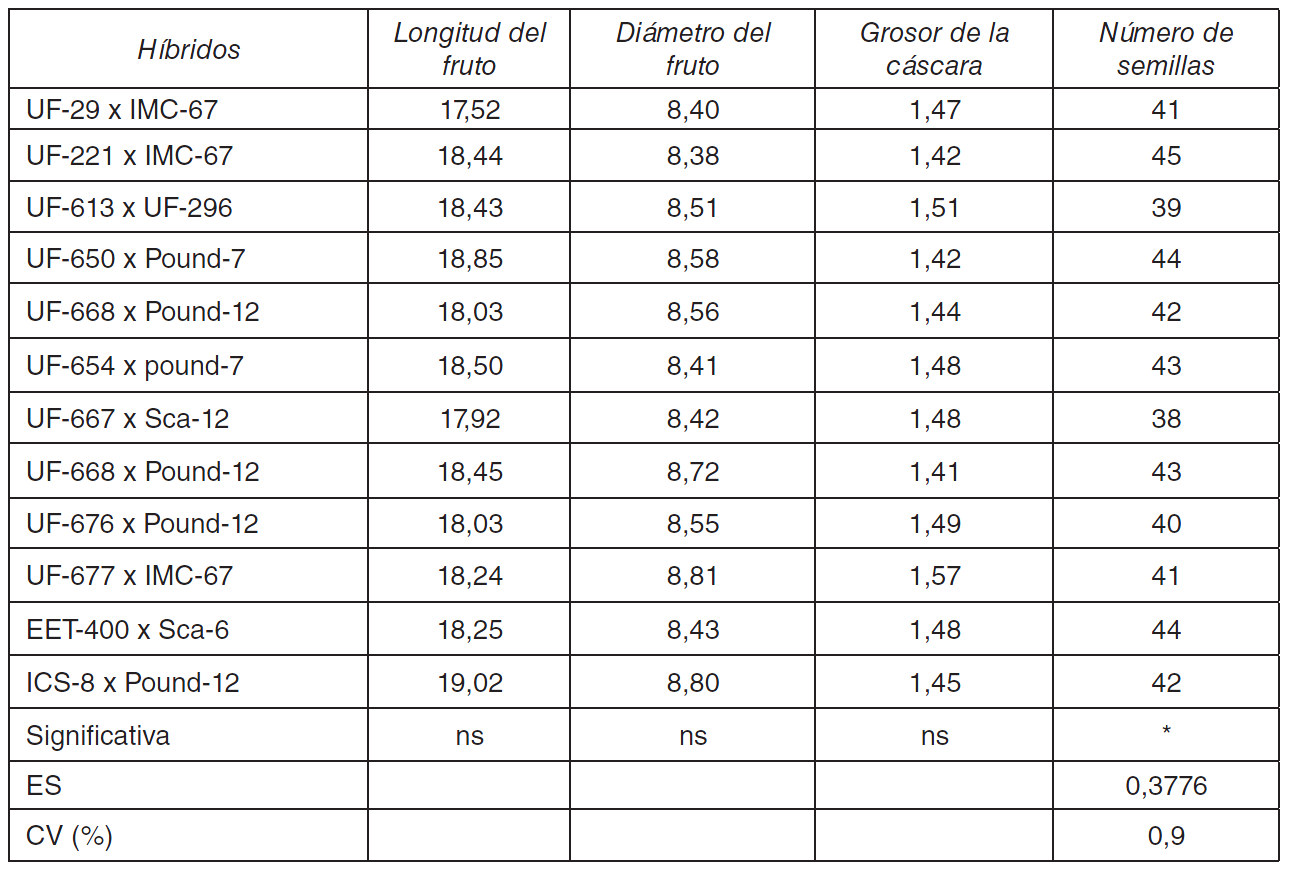
With the objective to evaluating the production stability of the cocoa hybrids cultivar descendants were planted in the Baracoa region on an Alluvial Humic Gleyed soil, at 28 meters over sea level. An experimental blocks design at random was used with five replicates. For the first four harvest and the one blunts it was evaluated: total number of ears, yield of dry cocoa and the half mass of the ears. For the last two harvests complementary evaluations of characterization of the hybrid were carried out that included: longitude of the fruit, wide of the fruit, and number average of seeds for ears and of the shell thickness. The climatic data were considered during the experimental period. The hybrid UF-650 x Pound-7 and UF-654 x Pound-7 presented good acting in the different years and they were considered as stable, with yields average of 1.12 and 1.02 t/ha, superior in a 18 and 16 % to the populational stocking, respectively. The hybrid UF-668 x Pound-12 and EET-400 x Sca-12 were unstable with yields accumulated average of 1.31 and 1.58 t/ha and with better behavior in favorable years.
Article Details

This work is licensed under a Creative Commons Attribution-NonCommercial 4.0 International License.
Those authors who have publications with this journal accept the following terms of the License Attribution-NonCommercial 4.0 International (CC BY-NC 4.0):
You are free to:
- Share — copy and redistribute the material in any medium or format
- Adapt — remix, transform, and build upon the material
The licensor cannot revoke these freedoms as long as you follow the license terms.
Under the following terms:
- Attribution — You must give appropriate credit, provide a link to the license, and indicate if changes were made. You may do so in any reasonable manner, but not in any way that suggests the licensor endorses you or your use.
- NonCommercial — You may not use the material for commercial purposes.
- No additional restrictions — You may not apply legal terms or technological measures that legally restrict others from doing anything the license permits.
The journal is not responsible for the opinions and concepts expressed in the works, they are the sole responsibility of the authors. The Editor, with the assistance of the Editorial Committee, reserves the right to suggest or request advisable or necessary modifications. They are accepted to publish original scientific papers, research results of interest that have not been published or sent to another journal for the same purpose.
The mention of trademarks of equipment, instruments or specific materials is for identification purposes, and there is no promotional commitment in relation to them, neither by the authors nor by the publisher.
How to Cite
References
Almeida C., M. V. C. y L. A. S. Días: Recursos genéticos. En: Días, L.A. S. Melhoramento genéticos do cacaueiro. – Viçosa, Brazil: L. A. S. Días, ed, Cap. 5, pp. 163– 216, 2001.
Bosshart, R. P. y H. R. Van Uexkull: El cacao de altos rendimientos necesita fertilizantes y condiciones de cultivo apropiadas. El Cacaotero Colombiano, 12 (37): 13 – 15, 1989.
Carvalho, H. W.; Silva, M. L.; Cardoso, M. J.; Dos Santos, M. X.; Nilda, J. T.; Lemos de Carvalho, B. C.; Mauricio, M. A. e D. D. Medeiro: Adaptabilidade e estabilidade de cultivares de Milho no Nordeste Brasileiro no ano agrícola de 1998 / 1999. Agrotrópica, 12 (1): 21 – 28, 2000.
Eskes, A. B.; Engels, J. M. and R. Lass: Working procedures for cocoa germplasm evolution and selection, proceeding of the CFC/ICCO/IPGRI proyect workshop, 1–6 February 1998. Montpellier-France, International Plant Genetic Resources Institute, Roma, Italy, 2000.
Estévez, A.; González, M. E.; Castillo, J. y J. Arzuaga: Comportamiento del rendimiento y la calidad culinaria de un grupo de clones y variedades cubanas de papa. Cultivos Tropicales, 17 (3): 72 – 76. 1996.
International Cocoa Organization, Quarterly Bulletin of Cocoa Statistics: Cocoa year 2004/2005, XXXl (2): 71, 2005.
Kang, M. S. and H. G. Gauch: Genotype by environment interaction. CRC Press. New York. p. 5, 1996.
Lanchenaud, C.; Matamayor, J. C. and A. M. Risterucci: Implications of new insight into the genetic structure of Theobroma cacao L. for breeding strategies. Proc. Intern. Workshop on New Technologies and Cocoa Breeding. (eds. Bekele, F., End, M. and Eskes, A.). Kota Kinabalu, Sabah, Malaysia, pp. 89 – 107, 2001.
Mather, S.; Sharmo, S. and S. Kumar: Description of variation in the Indian accessions of the medicinal plant centella asiatica (L) urban. Plant Genetic Resources Newsletter, 135: 47 – 52, 2003.
Ministerio de la Agricultura, Cuba: Instrucciones técnicas para el cultivo y cosecha de café y cacao, CIDA, La Habana, p. 176, 1987.
Ministerio de la Agricultura, Cuba: Instituto de Suelo.
Nueva versión de clasificación genética de los suelos de Cuba, p. 64, Agrinfor, La Habana, 1999.
Ortiz, O.; Maria, T.; López, B. O.; León, P. I. and C. H.
López: Initial growth vigour and segregation in the in- ternational hybrid of cocoa Pound-7 x Rim-76 in Rosa- rio Izapa, Chiapas State. In: 11 Cientific Technological Agricultural, Forestry and Husbandry Meeting (Pro- ceedings). Huimanguillo, Tab. (Mexico). C E. Huiman- guillo. p.399, 1998.
Ramos, C. G.; Gómez, A.; La Cruz, C. y A. Azocar: Evaluación de una plantación de cacao Criollo Guasare. Relación entre la producción y parámetros de vigor. Agronomía Tropical, 15(2): 175 – 186, 2001.
Romagosa, I.; Ha. Seullrich, F. and P. M. Hayes: Use of the AMMI model in QTL mapping for adaptation in barley. Theory Applied Genetic, 93: 30 – 37, 1996.
Van Eeuwijk, F. A. and P. M. Kroonenberg: Multiplicative models for interaction in tree way ANOVA, with applications to plant breeding. Biometrics, 54: 1315 – 1333, 1998.
Varela, N. M.: “Los métodos Biplot como herramienta de análisis de interacción de orden superior en un modelo lineal / bilineal” [inédito], tesis de candidatura, Universidad de Salamanca, España, 2002.